
Inside a VC's Scorecard: The 6 T's of Startup Evaluation
The 6 T's Framework and Due Diligence Template
Welcome to Learning VC💡! I’m Luis Llorens and I write monthly about VC and fundraising.
Due diligence done badly kills good deals and funds bad ones. The 6 T's framework help me for first screening and early-stage assessment. But the real skill isn't knowing what to look for, it's knowing how much weight to give each one.
Summary
❇️ The 6 T’s Framework
❇️ How Evaluation Shifts from Pre-Seed to Series A
❇️ Common Mistakes
❇️ Due Diligence Template
❇️ The 6 T’s Framework
Every early-stage startup evaluation, especially when it’s a first screening call, ultimately comes down to 6 dimensions:
👥 T1: Team
Do the founders have a genuine information advantage from first-hand experience with the problem?
Are they hungry and ambitious enough to make it through the hard days?
🌍 T2: Total Addressable Market
VCs want bottom-up sizing with real assumptions for a market that is actively growing, and one that’s large enough for startups to scale into. Consider # of customers × ACV × realistic penetration.
⏰ T3: Timing (”Why Now?”)
You should be able to explain why your startup couldn’t have existed three years ago. The strongest startups can point to a:
macro trend
regulatory shift, or
technology inflection point
That makes the solution newly possible or urgent.
📈 T4: Traction
Evidence that demand is real:
Is growth organic (pull) or entirely paid (push)?
Do the unit economics have a credible path to working at scale, or is growth being subsidized?
🏰 T5: Trenches (Defensibility)
What stops someone from copying you? Classic moats include:
Network effects
Data advantages
High switching costs
Brand or reputation
Economies of scale
The best founders can name their moat in one sentence and tell you how it gets stronger with every new customer.
🛠️ T6: Tech (Product)
Iteration speed and fast releases are critical.
How much better is it? The standard is a product that delivers dramatically more value than the status quo, whether that’s through better performance, lower cost, or both simultaneously.
❇️ How Evaluation Shifts by Stage
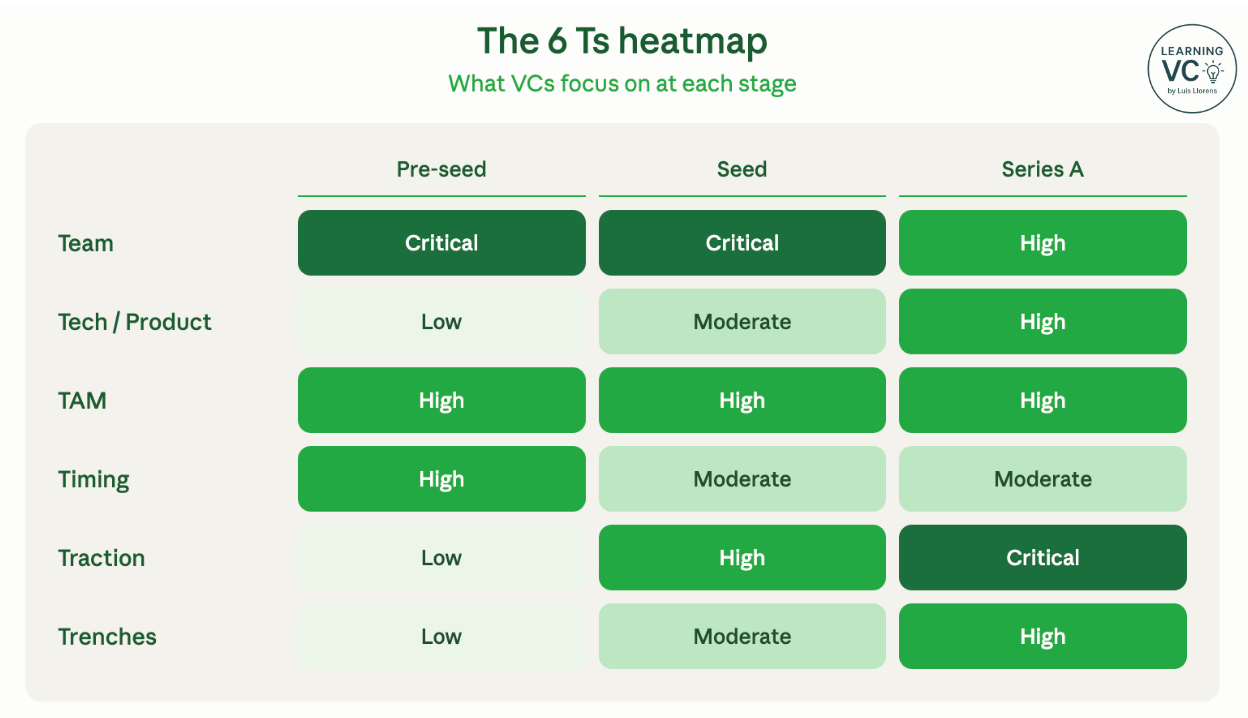
The 6 T’s always apply in early-stage assessment, but the weight of each one changes depending on where the startup is:
🌱 Pre-Seed
Have they found a problem worth solving? Are they the right team?
No product, no traction, no defensibility. The team is everything.
🌿 Seed
Does the engine work?
Product is live. The question is whether early users pull it from your hands or whether you're pushing it on them. Team, TAM and Traction dominate.
🌲 Series A
Can we pour fuel on the fire?
Traction becomes the headline metric. Defensibility (Trenches) matters.
❇️ Common Mistakes
Patterns I keep seeing in startups that stall between Seed and Series A:
Falling in love with the solution, not the problem. Most startups end up pivoting at least once, and the ones that survive are those who stay married to the problem while being flexible on the solution.
Hiring too fast before PMF. Before product/market fit, a bigger team often slows you down.
Chasing growth before retention. Pouring money into acquisition with a leaky bucket. You must first fix the product.
Focusing on revenue instead of the revenue machine. Investors want a repeatable engine, not just a number.
Not measuring what matters. CRM, product analytics, financial dashboards, and cash forecasting are a must.

❇️ The Due Diligence Template
To make this practical, I’ve put together the same Startup Evaluation Checklist I use when analyzing startups as potential investments. It covers 13 areas: Problem, Solution, Product, Technology, Market, Competitors, Team, Business Model, GTM, Traction, Financials, Funding, and a Metrics Reference Guide.

Whether you’re a founder preparing for fundraising or an investor running due diligence, it’s a practical roadmap to make sure nothing slips through the cracks.
🔒 Full access available exclusively for premium subscribers (or free trials).
By subscribing, you’ll also unlock:
Data Room Template
And more.
